Monday, March 11, 2013

Whatcha Need on Conclave's Eve

Scouring the streets of Rome the day before a papal conclave is a fascinating experience.

What is really about to unfold in the coming day?

Like so much of what the Catholic Church says, the happenings of a conclave not only borders on, but races straight into, the arms of the humanly impossible: the successor of Peter will be chosen. And he will be chosen in a line of unbroken historical succession, stretching back two millennia. And he will be given the grace to shepherd the universal Church that Jesus Himself founded. 

So today has been, well...strange, trying to take in the feeling, the atmosphere around Rome and the Vatican.

For some tourists who got lucky with scheduling, it's just a spectacle. For flippant and good-humored (but cynical) Roman restauranteurs, it's Rome just being Rome.  For politically and globally (but secular) -minded people, it's the interesting but dumbfounding creaking of a old dusty bureaucratic grandfather clock.   

But for the theologically minded--that is, those who see history as something which God has strangely entered into *(through the very unprecedented events recorded in the documents we call the Old and New Testaments) it is something quite indescribable: the election of the successor of Peter, the Vicar of Christ.

Remember how strange Peter is in the New Testament, especially the Acts of the Apostles. He denies Jesus when it counted most. Then, later on, his shadow heals people when it falls on them. He teaches so powerfully that thousands of people are baptized into the Christian life. He has mystical visions. Apostles like Paul submit their God-given teaching to him for approval. And, as the Gospels hint and history bears out, he humiliatingly sacrifices his life as a witness by a tortuous death, so calmly convinced he was that something worth living--and dying for--had begun in the death and resurrection of Jesus. 

But I guess what hit me today, walking around the almost-too-normal streets of Rome, was how everything Catholics believe about the Papacy as the succession of Peter and Peter's office in the Church (and therefore through normal, "secular" history), is utterly contingent on the active work and guidance of the Holy Spirit. The Spirit that came upon Peter and the other Eleven on that weird morning we call "Pentecost." The Spirit that the 115 men in red will invoke in chant tomorrow morning as they march into another upper room with locked doors. 


....With all this on my mind, I marched up the Gianicolo Hill on the Night Before the Conclave to the North American College (the "NAC"), and offered the Holy Mass at the Pentecost Altar in the crypt chapel. And there I prayed that God would guide the Cardinals (and the whole Church) by means of the absolutely necessary grace of a new Pentecost. Meaning that God would directly guide those entrusted with the universal Church, with Fire that cannot be seen, but whose effects are seen and experienced. 

Meaning that God would give us what we could never give ourselves: a shepherd who will feed His lambs, and tend His sheep, with Divine Life, with Heavenly Fire.  


Manic Monday: Rome 24 hours before a conclave

When the opportunity came up to come to Rome for the conclave, and I prayed that God would direct me to know whether I should do so as a quiet pilgrim in prayer, or share the experience of prayer via Social Media. I sensed that God wanted the latter, so I said, "God, I'm happy to share the experience with anyone you wish."

Since then, in my first 20 hours in Rome, I've bumped into all sorts of interesting media types here to cover the conclave.

For example:

On my flight from London to Rome, the man across the aisle asked me if I was going to the conclave. I said yes, and we had a lovely chat the rest of the flight. Turns out, the gentleman is Sean Klein, the Bureaux Editor for the BCC, for the entire continent of Europe. He is here with a huge gaggle of reporters from the BCC to cover the conclave. We chatted about journalism, languages, paparazzi, and how faith factors into the professional life of a journalist in Europe these days.


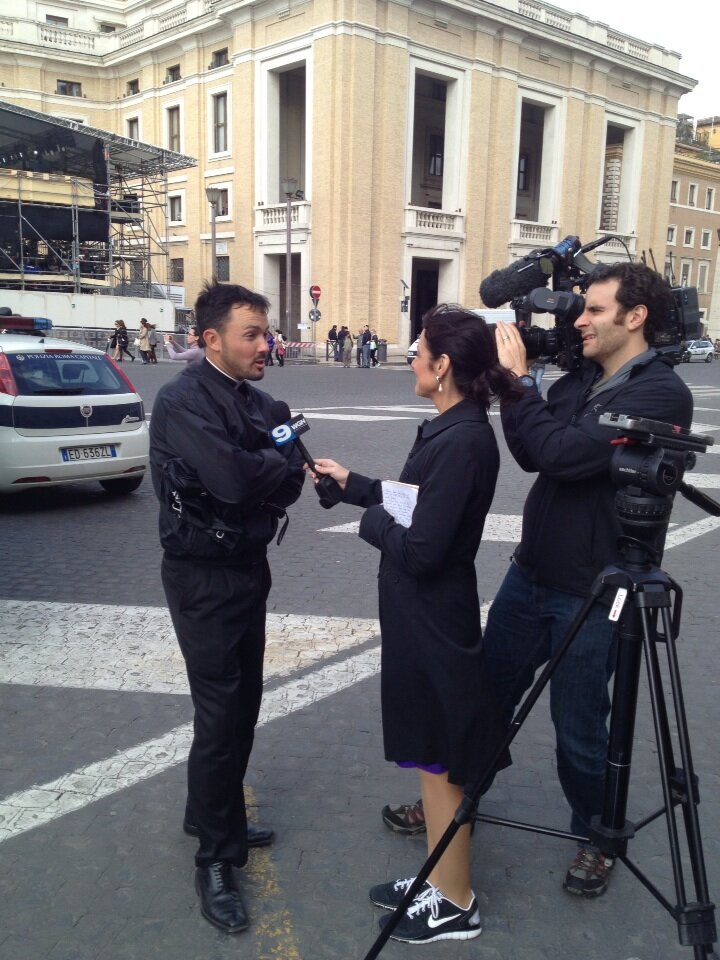
At the east edge of the St. Peter's square a host of journalists are gathered. I bumped into the team from WGN in Chicago and chatted with them about why I am in Rome and what the conclave means to me as a priest and a Catholic. They were particularly interested in the fact that I studied in Chicago at Mundelein Seminary for 5 years. Watch WGN tonight and see if my mug gets on there. On the WGN website they said they spoke with a seminarian from Chicago...um, hey WGN, I hope you didn't mean me. I'm neither. Check out my beard, you know? I'm old!


Later in the day, strolling by the well-known Via Borgo Pio just north of the Vatican, I bumped into Fr. Jonathan Morris from Sirius XM. He has been doing wonderful short interviews with Cardinal Dolan from the North American College.

There is a calm anticipation all around Rome, perhaps it would seem like a normal March day, except for details here and there...The windows of the Apostolic Palace shuttered. Pictures of Pope Benedict XVI Emeritus on the back of buses, with the word "Grazie!", "Thank you!" above it. Press boxes going up in random places. And my favorite...I was sitting outside at lunch enjoying great, simple Roman pizza with seminarians and priests and other friends, when we saw a cardinal quietly duck into the front door of the little church just behind us.

Apparently he has something on his heart to bring to prayer.

Saturday, March 9, 2013

GOING TO THE CONCLAVE!

I'M GOING TO THE CONCLAVE!!!!!!!!

Now, slightly calmer...

I'll be in Rome starting the Sunday before the conclave. I'll be there as a pilgrim and a priest. And I'm looking forward to sharing the experience with everyone who is interested in my experience there. I plan on being all around the goings-on around the Vatican. I predict the unpredictable!

I'll posting here on this blog a few times a day. I'll be tweeting from @Fr_JMuir and also on my Facebook page, for FrJohn Muir. Feel free to follow along, comment, and above all, to pray with me!

Friday, March 8, 2013

priesthood and a dead end

As we get ready for the election of a new Pope, let's refresh our memories about how central to Jesus and the Church--and indeed, the Papacy--is the notion of priesthood.  And if I'm not mistaken, this is first time in a video Fr Barron has ever said the words, "I'm the emperor of China."

Don't we sometimes find ourselves--perhaps unconsciously--making similar assumptions as Garry Wills? When in fact the New Testament present Jesus--Fr Barron is saying--as restoring and transforming the notion of priesthood in his person and work.

Monday, October 15, 2012

Year of Faith...it's on, and here's why


Happy new year...the new “Year of Faith.”
What's the Year of Faith about? What's it for? 

Both the Holy Father and Bishop Olmsted have said that the year is really two-fold: first, the rediscovery and recommitment of our faith on a deeply personal level; and second, to dedicate ourselves to renewed efforts to proclaim, teach, and, when necessary, to defend our faith in Christ.

Our central conviction as Catholic Christians is that God has come to us in His Son Jesus Christ, and invited us into an unimaginable friendship that will never end.  Faith, then, is the door to this friendship. Our Catholic faith is the fullest expression of this friendship with God up and down the centuries. The Church doesn't just have a mission; the Church is a mission. 

I couldn't think of a more exciting time to be Catholic than right now, to take up the challenge of renewing our faith and our commitment to proclaim it in re-energized ways.

To best understand the context of the year of faith, we have to see it in light of the Second Vatican Council. 

Fifty years ago the Second Vatican Council had its opening session in October of 1962. What was the situation at the time? Europe, and actually much of the developed world, lay exhausted and scorched by two World Wars of unprecedented destruction and cost. Two bombs added to the uncertainty of the future, one literal and one figurative: the atomic bomb and the pill. The first unleashing technology's power over the future of human life, and the second harnessing technology's power of the origin's of human life. Our beginning and our end seemed to be in our own trembling hands. A time of terrible threat and exhilarating promise. 

And God sent us Pope John XXIII, good and jovial and rotund Pope John, who with sense of humor and humility galvanized the Church with a new sense of hope. He signaled that the Church was abandoning her defensive crouch behind her walls, and throwing open the windows, so that the world might see in and the Church might see out. The Church, he knew, possesses the Good News of Jesus Christ, the "Light to the Nations," Lumen Gentium, and it was time for that Light to Shine forth in a new brilliance.

How did the windows of the Church end up closed?

Let me take you back about four hundred years, to the origins of what we call modernity, a whole philosophical movement whose central concern is the subject, or the interiority of the individual. The self. 

You know of the great founding fathers of modernity from your philosophy classes: from Rene Descartes' wrecking ball of radical doubt, finding solid ground only in the thinking and doubting self "I think therefore I am,"...to Martin Luther's obsessive search for certainty over his own personal salvation in which he wielded his wrecking ball against anything exterior to the interior act of faith...to Immanuel Kant's conviction that the human person cannot be used as a means to something else, but must be treated as an end in him or herself...

This was all new, this turn to the subject, to the interior life of the individual, to personal human dignity. And obviously, there is much to say for this, the modern notion of human rights, just to mention one positive. 

But an obsession with the scientific method as the privileged way to knowledge, coupled with radical skepticism about the past--and a prejudice against anything exterior to the subject--led to a fundamental equating of the old with the bad, and the new with good. This attitude found expression in the last years of the 1700's, in the so-called Enlightenment.

In 1789, this movement showed its dark underbelly, its bloody teeth. The French Revolution in particular--a vicious reaction against the past and its accoutrements--led to priests, nuns, bishops, normal Catholics, too, being imprisoned, tortured, executed. This experience penetrated the heart and memory of the Church with a deep wound. And, consequently, a defensive posture resulted. 

Through the 1800's this defensive posture endured, expressed clearly in any number of official Church condemnations against the heresies of modernity. The first Vatican Council, in 1870 began to provide a response beyond this evangelically weak defensiveness, but was cut short due to war, and so the Church's response remained in suspense. 

But by the middle of the 20th century, with the Church holed up behind her walls, dust settling on the incalculable physical destruction of war, we modern people found ourselves wandering through bombed out cities, literally and figuratively picking up the smashed fragments of meaning and purpose. In the 20th century, many voices provided clues to the search for purpose and meaning (e.g., Karl Marx: the material of production and economics; Sigmund Freud, the latent forces of sexual desires; Jean Paul Sartre, freedom from nature in favor of radical autonomy; Friedrich Nietzsche, the will to power.) 

We couldn’t quite put Humpty Dumpty back together again...in a way that the modern culture found convincing. None of these competing voices could provide the personal and cultural resurrection for which modernity was searching.  

So, prompted by Pope John XIII, the Church came to grips with this: in her defensive crouch, her voice was not being heard. Modernity--despite its conviction to the contrary--had never really heard the Gospel. 

Like the rich young man in the gospels, the modern world had never really heard the voice of Jesus Christ saying, "If you want eternal life....sell what you have, give to the poor, and follow me!" Like the young man, fascinated only with his own devices, the modern world couldn't see past its own interior powers to the Other, to God, to Christ; it had not yet learned to be fascinated with following the call of crucified Love. 

So it dawned on Pope John XXIII: the modern world hadn't really rejected the gospel. It hadn't heard the gospel, the good news, at all. And the Second Vatican Council proposed to renew the faith of those who had met Jesus Christ, and then unleash them like a living fire into the world. This wasn't a Council to condemn heresies; it was a Council to captivate "modern" hearts and turn them loose ablaze with divine Love. 

Bishop Olmsted said at the opening Vespers for the Year of Faith that every Council in history is usually followed by 50 years of craziness and confusion, and then, often, great things happen. He said, "We're right on schedule." But the success of the Council is no guarantee. Some Councils that wanted great reforms fizzled out. In 1517 the V Lateran Council proposed great reforms. Catholics shrugged their shoulders and the response was underwhelming. Four years later the Protestant reformation erupted. 

Some Councils succeed. Perhaps most of the (there have been 21) were great successes, like the Council of Trent, for example, in 1570--exploding into wildly fresh displays of faith in art, music, teaching, preaching, missionary life, ethical reforms, etc.  

What about the Second Vatican Council, whose texts are our marching orders? Will it fizzle, or will it change the course of history? It's for us to decide, you and I. This is our time to live, to decide, to act. 

The Council's success will depend on our faithfulness to Christ. On our holiness; on our distinctive happiness of life. Will we--we modern people, so in tune with the unique desires of the subject, the self, the person--will we receive and share the Light to the Nations in the way radical way the Council invites us to? 

Even though our generation hangs in the balance, as does every generation, finally we know the victory is Christ's. This is our faith. In him, our victory is assured--for if God is for us, who can be against us?

Monday, February 6, 2012

Jesus and the Rise of a new Fatherhood

It's rarely spoken about, but one of the undercurrents in the Gospels is the way that Jesus heals broken fatherhood. He heals all creation, but in a particular way, he comes to heal our image of fathers and fatherhood. "When you see me, you see the Father," he says in the gospel of John.

But look how clearly and strikingly the readings from Mass a few days back make this point: Mark 5:21-43, and 2 Sam 18.

Jairus, the synagogue official, implores Jesus to heal his daughter who is on the point of death. There is no indication that Jairus is a bad father at all; in fact he seems to be doing all he can to help her. But that's just the point: earthly fathers alone cannot provide what human beings really need, no matter how good they are. Jairus cannot save his daughter from death, even a young death. Jesus responds by going off with him to help her, to provide what this good-willed father cannot provide on his own: life.

On the way, Jesus meets another hidden crisis of fatherhood. A woman who had a hemorrhage meets him. Mark tells us she had suffered greatly at the hand of many doctors and had spent all she had. But she only got worse. Though the text doesn't tell us explicitly, there is an implicit judgment we might draw: where was her father? Why was she pouring her resources and not him? She is apparently alone and growing destitute and hopeless on her own. Her father could not protect her from illness and social stigma and poverty. Maybe he tried his best, maybe not; but he is not there. He's gone. She's alone. If this theme of fatherhood seems a stretch, simply hear what Jesus calls her when he finally lays eyes on her: "Daughter." In touching his cloak, she touches the power and love of a Father who loves her. And she is healed.

But during this delay along the way, it seems that Jesus has failed as a substitute father to Jairus' daughter. The report comes that she had died. It seems as though Jesus claim to simply heal the girl and restore her to her father is ridiculous. The crowd laughs at him and mocks him. After all, too much damage is done, too much water under the bridge. He ignores the nay-sayers and proclaims, "The child is not dead but asleep." Even physical death does not put the girl outside of his fatherly care, though she is out of the reach of Jairus.

Jesus remarkably takes on the role of the father of the house: he tells certain people to leave the house, guides the parents (it is their house!) through the house to the girl's room, and takes the child by the hand. She arose immediately. His fatherly providence continues, telling them to give her something to eat. While he restores the parents to their role in the girls life, it is clear that Jesus brings a fatherly identity and power with greater authority than that of natural parents and even the forces of nature.


How often do we think of Jesus as a father? Recall that he is called the "son of David" on several occasions. David himself was a father whose love for his son was stronger than even the most heinous betrayals. When his rebellious and treasonous son Absolom is finally killed, David cries out, "My son, Absalom! My son, my son Absalom! If only I had died instead of you, Absalom, my son, my son!" If this is true of David, how much more true is it of Christ, who consummates the desire we see in David's heart, to die for his beloved child on the Cross?

Especially for us men--whether fathers physically or spiritually, directly or indirectly--we can find great strength knowing that Jesus opens up for us a great hope: he is fatherhood healed of all brokenness, neglect, and selfishness. We men are hard-wired to give and protect life, but this can seem to daunting to commit to for a lifetime, or, given our own weaknesses even for a week, sometimes. But Jesus comes to undo the fall, and this includes the fall of the first father. He gives life and protects us in His Church. He can teach us how, too.

Tuesday, January 10, 2012

Treasure under the house: the intellectual riches of Christology

If you asked me what my favorite class was, in all those great years during my formal studies for the priesthood...I'd say probably Christology. The study of Christ. Sounds funny, but until I arrived at the hallowed halls of my two seminaries (in Denver and Chicago, respectively), I honestly had no idea such a thing even existed.

At first hearing, I thought "Christology" was a joke. Literally. Or, at best, I thought maybe it was a topic some professor had made up on a whim, with tongue slightly in cheek. The study of Christ? Who ever heard of such a thing? The "logy" of bio-logy...socio-logy...anthropo-logy...that seemed to make sense given the relative pin-downability of those areas of study (life, peoples, man, etc.). But taking class on the Lord Jesus? What do we think he is, a dead butterfly? It was like taking a class on my Mom, or my Dad. How would you possibly catch and study someone so mysterious and, well, huge? I assumed: "I know Jesus... I don't need a class on him."

Turns out, Christology was, and is, pretty darn real. In fact, I discovered that the first six or seven centuries of Church history resembled a long intellectual wrestling match of the greatest human minds with answering this basic question: Who the heck is Jesus Christ? How can we possibly make sense out of Him?

I realized that, despite my Catholic upbringing (no, I didn't go to Catholic schools growing up.)  how little intellectual content I possessed regarding some somewhat simple questions: How was Jesus God and man? Did he have a soul? Did he know everything? How did he pray? Did he fear death? Did Jesus know he was God? Did he have two minds? Did he know he would rise from the dead? Was Jesus Jewish or Catholic or both or neither? Did Jesus think about me while he was on the cross?

I took the class--it was January, 2004--and my Christology class blew me away--not because it was the best-taught class necessarily, or because class interaction was the best, but because the intellectual content which provided logically coherent and rich answers to these questions was like discovering a massive cave of treasure under my house. I had no idea, but it was there all along, and my mind started coming alive as a Catholic in a new way.

The treasure I discovered was made up of intellectual heroes, giants, speaking to me from across the centuries: Sts. Paul, Iranaeus, Athanasius, Cyril of Alexandria, Gregory of Nazianzen, Basil and Leo the Great, Augustine, Ambrose, and a host of others, unfolding the Mystery of Christ in ways I intellectually thirsted for, thought I hardly dared to ask the questions.  I had never experienced my heart and my mind being so united and exhilarated by anything quite like that ever before. These men helped to transfer me, whole and entire, from adolescence to adulthood in terms of my Catholicism; they certainly also helped me entertain the feasibility spending all my twenties studying Christ full-time, which I ended up doing.

Now, as a priest at the largest university in the United States of America, I'll be sharing some of these riches in a weekly Christology course for any interested students. It'll be my first crack at teaching a university level course on campus--thought not-for-credit--but I'm very interested to see what kind of discussion and interest it generates. In an environment that often scoffs at the intellectual rigor of Christianity, I hope it will be helpful. If the material has half the effect on others that it had on me in my twenties, it'll be well worth the effort.

See www.asucatholic.org for details on the free class.