Saturday, June 21, 2014

The Longest Day

In the 19th century, a Christian asked a famous Rabbi why Jews do not have a catechism, a written summary of their beliefs. The Rabbi answered, "The Calendar is our catechism." For a Jew, the rhythms and rhymes of the calendar formed a narrative which was meant to be lived. The catechism was not read as much as it was experienced as the year unfolded.
It's true for Catholics, too, as we live our own liturgical calendar (which is essentially the Jewish calendar transformed around the person and life of Jesus). 

There are so many treasures hidden in the calendar. Here's one I find particularly rich, especially if you're a sun lover. It's about the theological meaning of longest day of the year, the Summer Solstice, June 21.

Look at the calendar and you'll see that it is the Memorial of Saint Aloysius Gonzaga. Which may seem innocuous enough. 

But zoom out a bit--bear with me if you dare--and you'll see that June 24 is the Feast of the Nativity of Saint John the Baptist. Spin the calendar like a globe and you'll see that perfectly opposite this on the calendar is the Nativity of the Lord Jesus Christ, December 25 (obviously Dec 24 being the Vigil). 

What does it mean? Saint John the Baptist is born just as the light begins to fail. Similar to many of the Old Testament prophets, his arrival both announces--and through that divine word--it also triggers the darkness, which is summed up by collapse of the cosmos. John the Baptist is "Elijah" whose entrance onto the scene initiates famine and strife...almost to the point of complete darkness. He--Elijah in the Old and John the Baptist in the new--brings the situation to point of trial, tribulation, desperation and darkness. 

The point is St. John the Baptist triggers--and his birthday on the calendar liturgically coincides with--the diminishment of the light and warmth, two things we need for life. Recall that John Himself said as much of himself: "I must decrease" (John 3:30). 

And so in our experience of our annual lived "catechism" we experience the diminishment of light at the coming of the greatest Prophet, John the Baptist, who announces and triggers the attack of darkness that the Lord Himself will overcome. Just as John the Baptist and Jesus worked in a kind of tandem of inverse complementarity, so the two halves of the calendar: From June 24 onward, the light and warmth of the sun gradually, if imperceptibly, diminishes...right up until Dec 24, when in the that dark and cold of Christmas Eve, Christ is born....of whom John says, "He must increase" (John 3:30).

Just to make the point clearer, St. John the Baptist will liturgically diminish into his own darkness on August 29, when we celebrate his beheading. The light will continue to fade until, as I said, the birth of the Light on Christmas, and gradually His work of restoring the cosmos will gradually unfold. In Holy Week, His struggle with darkness and death with its climactic moment when He dies, rises, ascends and sends the heavenly fire of the Holy Spirit at Pentecost (all this happening usually in March or April).

So: since Jesus' gift of the Holy Spirit is able to recreate and perfect all of creation, the light and warmth continues to expand until June 21st...the longest day of the year. What John the Baptist announces and inaugurates--the coming of God's judgment on this world--Jesus brings about (in the Cross) and overcomes (in the Resurrection, etc). All this is indirectly and quietly packed into the liturgical experience of June 21, and the surrounding bright days. 

In Arizona where I live, June 21st is long. The sun stays in the sky seemingly for ever. It always makes me think of that mysterious vision that St. John has in the Book of Revelation of when Heaven and Earth definitively come together, and God's creation is perfected. He says, "The night will be no more. They will need no light from lamps of the sun, for the Lord God will be their light." June 21st is meant to be an experience, a delightful and earthly reminder, of this theological truth of the future. (I can't imagine how must more "eternal" the day feels in Alaska or other more Northerly places on June 21st). Shout out to you Michiganders. 

So that's what June 21 means on the Catholic liturgical calendar. It symbolizes the day when the Light of Christ has expanded to fill every dark nook and cranny of creation and when the "night" of sadness and death will be no more. 

It teaches us not to fear when God allows the light to diminish (who is the Elijah and John the Baptist in your life? Who in your life "triggers" your humility and helps your ego and plans to diminish? Follow them!). 

It teaches us that when we let God (however humbly and imperceptibly) into our lives in the silent and dark of Dec 24...He will, if we permit Him, make us to resemble, little by little, the glory of June 21.

So I give you June 21st: the longest--and probably a rather unnoticed but nonetheless awesome--day of that Catholic catechism we call the calendar.  

Friday, June 20, 2014

Seeing the price of her freedom

For all those who desire deeper interior freedom...or wish to understand the deepest causes of real freedom...consider these words on St. Mary Magdalene from the great and late Fr. Hans Urs Von Balthasar. It's meaty and dense, but give it a shot. I'm on my third read of it today. Good stuff. I'd love to know what gems you find in it. Let me know!

from Magdalen
 by Hans Urs Von Balthasar

"At the Cross she learns how much it cost him to deliver her from seven demons.  Even before that she was certainly filled with nothing but gratitude and had placed all she had at the disposal of Jesus and his followers.  Freed from a sevenfold servile bondage, she had entered a freedom unknown to her like one who steps out of a gloomy dungeon into the open air.  Everything within her was drawn toward her liberator, to whom she owed a completely new existence exceeding all her hopes.  For these reasons what she experiences at Golgotha cannot be put into words.  Her liberator cruelly nailed up in a tortured death agony and she, the one he set free, unable to do anything at all to free him.  Moreover, she knows, unbearably, that her freedom to love him is purchased by this torment.  She cannot return to her prison and thereby set him free; she must simply endure having her freedom paid for with this breathtakingly high price.  She realizes that her offer of love can do nothing now to brighten the dark night of his abandonment by God.  She cannot offer her suffering as a balm for his.  His is alone, on the other side of a broken bridge.

She cannot make herself useful in any way.  She hears the death rattle, sees the blood run from his open side, but it is the men who take the corpse down after Joseph of Arimathea finally returns from seeing Pilate and buying the linen.  They may have laid his body on his Mother's lap, but certainly not on Mary Magdalen's.  She is an observer and remains one while the corpse is prepared for and finally placed in the tomb, which is then sealed.  "Mary Magdalen and the other Mary stayed there, sitting down across from the tomb" (Mt 27:56).  Behind the stone that cut off her line of vision lay what had once been her life.  For the entire following day the stone of the Sabbath weighed heavily upon her existence and robbed her of all action.  "On the Sabbath they rested according to the law" (Lk. 23:56)
Then comes the report of a Resurrection morning that cannot be entirely reconstructed with certainty: carrying their spices, the women find the open tomb; Magdalen runs to the disciples to give them the news (before or after the angels' proclamation in Mk 16:5-7?) and then finds her solitary way back to the grave for the great scene reported in Jn. 20:11-18.  Neither the gaping emptiness nor the conversation with the two angels who sit at the head and at the feet of a missing corpse, not even her words to the supposed gardener, can drive the opaque darkness of Good Friday away from the woman's soul.  Only with the name: "Mary" does the whole light of the Resurrection flood into her.  And therewith the heavy rock that separated her from her Master under the Cross is pushed aside: "Mary - Master" is a pure merging of love.  Yet in the same moment a new curtain of separation falls: "Don't hold on to me."

The woman must hold.  The man holds not: he takes hold and lets go; he goes his own way, does his own deeds.  But in his taking hold he forces the woman to hold, and she will hold the child in a completely different way than he.  And, if the man holds her not, she has a deep desire to hold God, to present herself to him as a "bride" whom he cannot leave behind.  The same applies if Mary is personam Ecclesiae gerends, that is, playing the role of the Church, as the Church Fathers say: the Church must also grant freedom to her Bridegroom ("If it is my will, what does that matter to you?" Jn 21:22-23).  For that is the only way she receives the freedom of Easter.  As she lets go, she can receive Jesus' message for his brethren; had she clung tight in spirit, she would never have been able to carry it out.  The Lord granted the woman - both as the Church and as the individual - freedom to say nothing of her experience with him and rather simply to pass on his message.  "Mary Magdalen went thither and announced to the disciples: I have seen The Lord, and that is what he told me" (Jn. 20:18).

The men - who dismiss the women's message as "empty talk" and receive a scolding from Jesus for having done so - take over the proclamation of the Resurrection, with Peter as their head.  The message of the women disappears behind them (in Jewish law women were not legitimate witnesses).  But this message dare not be forgotten, for it is the message of that Church who was present at the end of the Crucifixion and the first to be granted a glimpse of the Resurrection.

Wednesday, December 4, 2013

3 minute celebration of 50 years!

You know you're freaking out, just a little. Admit it. Today, Dec. 4,  is the 50th anniversary of the promulgation of the first major document of the Second Vatican Council, the Constitution on the Sacred Liturgy (known by the shorthand Latin name Sacrosanctum Concilium). 


And if, like me, you are kicking yourself for not throwing a huge party and/or taking the day off to meditate on this awesomeness, fear not! 

I took the liberty of sketching out a little cliff-note-like sketch of the highlights what the Council said about the liturgy, using--get this--the words of the Council itself, and that from (for the most part) the Constitution that today turns the big five-0. This blog's name is inspired by the very purpose of the Sacred Liturgy. If you get that, you get a lot of what the Council wants us to know. 

Skim it, pour over it, or glance at it--either way, happy 50th, SC!


What is the Sacred Liturgy, according to the Second Vatican Council? 

The sacred liturgy, especially the divine sacrifice of the Eucharist, is where “the work of our redemption is accomplished.” (SC 2)

The sacred liturgy is the action whereby Jesus Christ the High Priest performs “full public worship,” in his Mystical Body, that is, “the Head and his members.” (SC 7)

The sacred liturgy is a “foretaste of that heavenly liturgy,” which is celebrated in heaven, where Christ sits at the right hand of God with all the heavenly army.” (SC 8)

Mass is inseparably the following things: the sacrifice of the cross, a memorial of the Paschal Mystery, a sacred banquet of the Lord’s Body and Blood, and the foreshadowed and anticipated eschatological banquet “when he comes.” (Eucharisticum Mysterium, EM 3a, a few years after SC).


What is active participation, according to the Second Vatican Council?

Participation in the Lord’s Supper is always communion with Christ offering himself for us as a sacrifice to the Father. (EM 3b: *quoting Mediator Dei)

“In liturgical celebrations each person, minister, or layman who has an office to perform, should carry out all and only those parts which pertain to his office by the nature of the rite and the norms of the liturgy.” (SC 28)

The Nature of Active Participation in the Mass: The priest alone, in persona Christi, consecrates the bread and wine, but the role of the faithful is the Eucharist is to recall the passion, resurrection, and glorification of the Lord, to give thanks to God, and to offer the immaculate victim not only through the hands of the priest, but also together with him; and finally, by receiving the Body of the Lord, to perfect that communion with God and among themselves which should be the product of participation in the sacrifice of the Mass.” (EM 12)

“(The faithful) should give thanks to God. Offering the immaculate victim not only through the hands of the priest but also together with him, they should learn to offer themselves.” (SC 48)

“The faithful participate more fully in this sacrament of thanksgiving, propitiation, petition and praise, not only when they whole-heartedly offer the sacred victim, and in it themselves, to the Father with the priest, but also when they receive this same victim sacramentally.” (EM 3e)

To produce its “full effects,” the faithful must come with “proper dispositions,” with “minds attuned to their voices,” understanding what they are doing, to be “actively engaged in the rite and enriched by it.” (SC 11)

“The Church, the spouse and minister of Christ, performs together with him the role of priest and victim,” offering Him and herself in union with Him. (EM 3c)

This sacrifice “has no effect (in the faithful) except in those united to the passion of Christ by faith and charity;” the benefit {not the sacramental validity, etc) for the faithful is “in proportion to their devotion.” (EM 12)

The community, in its unity, is arrange in hierarchical order. Therefore, “each person, performing his role as a minister or as one of the faithful, should do all that the nature of the action and the liturgical norms require of him, and only that.” (EM 16)

Concretely speaking, What did the Second Vatican Council say about sacred art and other externals used in the liturgy?

“In liturgical celebrations each person, minister, or layman who has an office to perform, should carry out all and only those parts which pertain to his office by the nature of the rite and the norms of the liturgy.” (SC 28)

In Catholic institutions and schools, “great importance is to be attached” to the teaching and practice of the “treasury of sacred music.” (SC 115)

Sacred Music forms a “necessary and integral part of the solemn liturgy,” and is a “treasure of inestimable value,” greater than any other art.” (SC 112)

The purpose of sacred music, like that of the divine liturgy itself, is “the glory of God and the sanctification of the faithful.” (SC 112b)

 “Care must be taken to ensure that the faithful may also be able to say or sing together in Latin those parts of the Ordinary of the Mass which pertain to them.” (SC 54)

All things set apart for divine worship should be worthy, becoming, and beautiful, signs and symbols of things supernatural. (SC 122)

In the sacred arts, e.g., sacred art, vestments, and ornaments, etc., “noble beauty” is to be sought. (SC 124)

 “The use of the Latin language, with due respect to particular law, is to be preserved in the Latin rites.” Vernacular may be used, “especially in readings, directives and in some prayers and chants.” (SC 36)

Regulation of the sacred liturgy depends solely on the authority of the Church, that is, no the Apostolic See;” therefore, “no other person , not even a priest, may add, remove, or change anything in the liturgy on his own authority.” (SC 22)

 “Liturgical ceremonies should be celebrated with the utmost perfection.” For this reason: The rubrics are to be observed carefully, under the watchful scrutiny of the ecclesiastical superiors. (IE 13)

 “In the celebration of the Eucharist above all, no one, not even a priest, may on his own authority add, omit, or change anything in the liturgy.”  (EM 45)


Where are concrete instructions for the celebration of the liturgy be found?

The Typical Edition of the Roman Missal is the primary source for the “what’s” and “how’s” of the Mass. The General Instruction of the Roman Missal (GIRM, or IGMR) has further clarifications. Book IV of the Code of Canon Law has helpful laws and principles for the liturgy. The above mentioned Conciliar and post-Conciliar documents are helpful. The U.S. bishops council also published liturgical documents, available at www.usccb.org. Other privately written books are helpful, e.g., Elliot, Peter. Ceremonies of the Roman Rite, San Francisco: Ignatius Press, 1995.


HAPPY 50th, Sacrosanctum Concilium. In some ways, you're just beginning. 


Thursday, June 27, 2013

Marriage, Fatherhood, and Being Complete


The Supreme Court's recent legal decisions regarding marriage certainly add to the growing list of reasons to be worried that our nation's public culture is careening toward a moral and social cliff. 
It's easy to feel distressed.  
It's easy to feel helpless. 
But there are a lot of wonderfully helpful things we can do. One simple thing we can do every day is to celebrate the amazing gift of fatherhood and motherhood--the direct fruits of marriage. 
If we remember the amazing good that fatherhood is, for example, I think that it will help us rediscover the unique good that marriage is. 
We just had Father's Day here in the USA. And, coincidentally, Pope Francis said this about fatherhood: 
"When a man does not have this desire [to be a father], something is missing in this man. Something is wrong. All of us, to exist, to become complete, in order to mature, we need to feel the joy of fatherhood: even those of us who are celibate. Fatherhood is giving life to others, giving life, giving life..."

 I’m blessed with a wonderful father. My Dad (that's my Dad on the far left getting a big kiss from my brother) filled my childhood with experiences of fatherly love. In my earliest years, he’d tuck us (five)  little Muirs in bed, pray with us, kiss us on the head, make us feel like we were the most special kids in the world. We just knew he loved us from the way he treated us. 


I assumed his fatherly tenderness to us was automatic. Fatherhood seemed so easy for him. It wasn’t until later in life that I learned my Dad’s love as a father didn’t come cheap. My Dad had been a top-rated college basketball referee when I was born. Against his shocked colleagues’ recommendations, at the peak of his career, he quit…so he could be home evenings and weekends. In my young adolescence, when his successful real estate business (“Muir Real Estate Corner”) began to sap time and precious energy from him, he sold it and became a high school teacher, so was home every day at 3 pm for my Mom and siblings. 
All of my father’s love and tenderness toward my mom and to us kids was purchased at a price. And it made him a great father.  
A Creative Vow. Years later, in the seminary, I came across something by the French Philosopher Gabriel Marcel called “The Creative Vow as the Essence of Fatherhood.”  He said that true fatherhood was born from a special “creative vow”: a father becomes a father not mainly through physical paternity, but through a creative promise in which a man vows to love a child in the “fidelity to a hope which transcends all ambition and personal claims.”  
In a flash, I saw it: my dad’s amazing fatherhood derived its vitality from his promise to embrace his kids without any reference to his own ambition and personal claims. I saw, in other words, that robust fatherhood is born of a weird creative weakness: dying to ambition, rising to relate to a child in a totally selfless way. 
 Gabriel Marcel said that this kind of “creative vow” has to be rooted in the eternity of God, because only God can sustain this kind of radical fidelity and love. During early mornings in my high school years, my Dad often returned from somewhere caring milk and donuts. I thought it was just Safeway. Turns out, he was going to daily Mass before hitting the grocery store. 
 I thought he just really liked donuts. Later I learned he went to daily Mass to receive strength from the “eternity of God” to keep living out the “creative promise” of his fatherhood.  

Fatherhood completes a man because it roots him in God, and teaches him to love. I'm so thankful for the amazing gift that marriage--through my parents--gave to me: Fatherhood. My Dad's fatherhood, and now the fatherhood I seek to grow in as a priest. 
Nothing else could take the place of what marriage gave to me: the experience of a father's love. 

My Two Dads, and other things I liked about "Man of Steel"

 I confess: I attempted to fly when I was a boy. On multiple (but, sadly, unfruitful) occasions. Though I was never too into any comic book superheroes, my wish to fly around and above the maple trees of Mayfair Park (my boyhoood neighborhood) made me relatively sympathetic to Superman.

And the sympathy remains. But now I am a Catholic priest, and I see flying in a slightly more spiritual way. I fly around the Diocese of Phoenix (in my car) fighting the things a priest fights. This, and other themes in the most recent re-hash of Superman, resonated with my life as a priest with varying levels of profundity. So I offer the following list of ways the life of a priest echoes with Superman in the film.

1. Superman has two Dads. Kevin Costner's character tells the young Superman something along the lines of "Clark, you have two Dads. I'm your Dad. But you have another Father who sent you here for a purpose." My Dad is Ronald Muir. But when I became a priest, I was sent with a mission by another father: my Bishop. Of course this is all rooted in Jesus Himself, who has an earthly father (St. Joseph), and a Heavenly Father. His mission was rooted in His being sent by God the Father.

2. Superman's mother is super important to his mission. A priest depends on the Blessed Virgin Mary to be the most important woman in his life, to comfort him, heal him, mother him. My favorite line of the movie was when Superman's enemy attacks Mrs. Kent, his mom, and Superman says, "You threaten my mother?!?" And then he goes ballistic. Loved that scene.

3.  Superman visits his priest/pastor for spiritual direction to help him discern what he should do in a difficult situation. Fight or run? Go public or hide? Protect himself or protect others? His priest/pastor listens and encourages him to trust what God is doing in his life, and his mission begins. I can't tell you how huge my spiritual director's counsel has been to me, and all the times I've received encouragements to make a leap of faith through good spiritual direction. I hope Superman has that priest's cell phone on his "Favorite" list. He's gonna need it.

4. Superman is immersed in human life before and after he begins his mission. I can't tell you how often people are surprised that a priest actually does human things...like, oh, I don't know....eat, sleep, sneeze, like sports, and lift weights. And any number of normal human things. Superman gets a job (journalism) that will maintain his connection with human life, even with his extraordinary vocation. Priesthood isn't exactly a "job", but our connection with the people we serve is essential. Pope Francis said, "Priests should smell like their sheep." Notice the stained glass in the church scene in the movie? It was of Jesus the Good Shepherd, surrounded by His sheep.

5. Funny clothes. And a cape. No, I generally don't wear it. But I'm ready to...just in case.

6. From Kansas. Two of the most important priest spiritual father-figures in my life have deep roots, like Superman, in Kansas: Archbishop Charles Chaput (accepted me as a seminarian) and Bishop Thomas Olmsted (from Kansas, and was bishop of Wichita, respectively). Coincidence? I think not!


   7. His childhood friends don't understand his vocation/mission.

  8. He frequently "gets away" to contemplate the world from a uniquely high perspective. Completive prayer, silent retreats....standing on clouds. 
  
  9. He changes clothes a lot.
   
  10. IHOP. 

Friday, March 15, 2013

Fingerprints of Providence: 3 amazing days


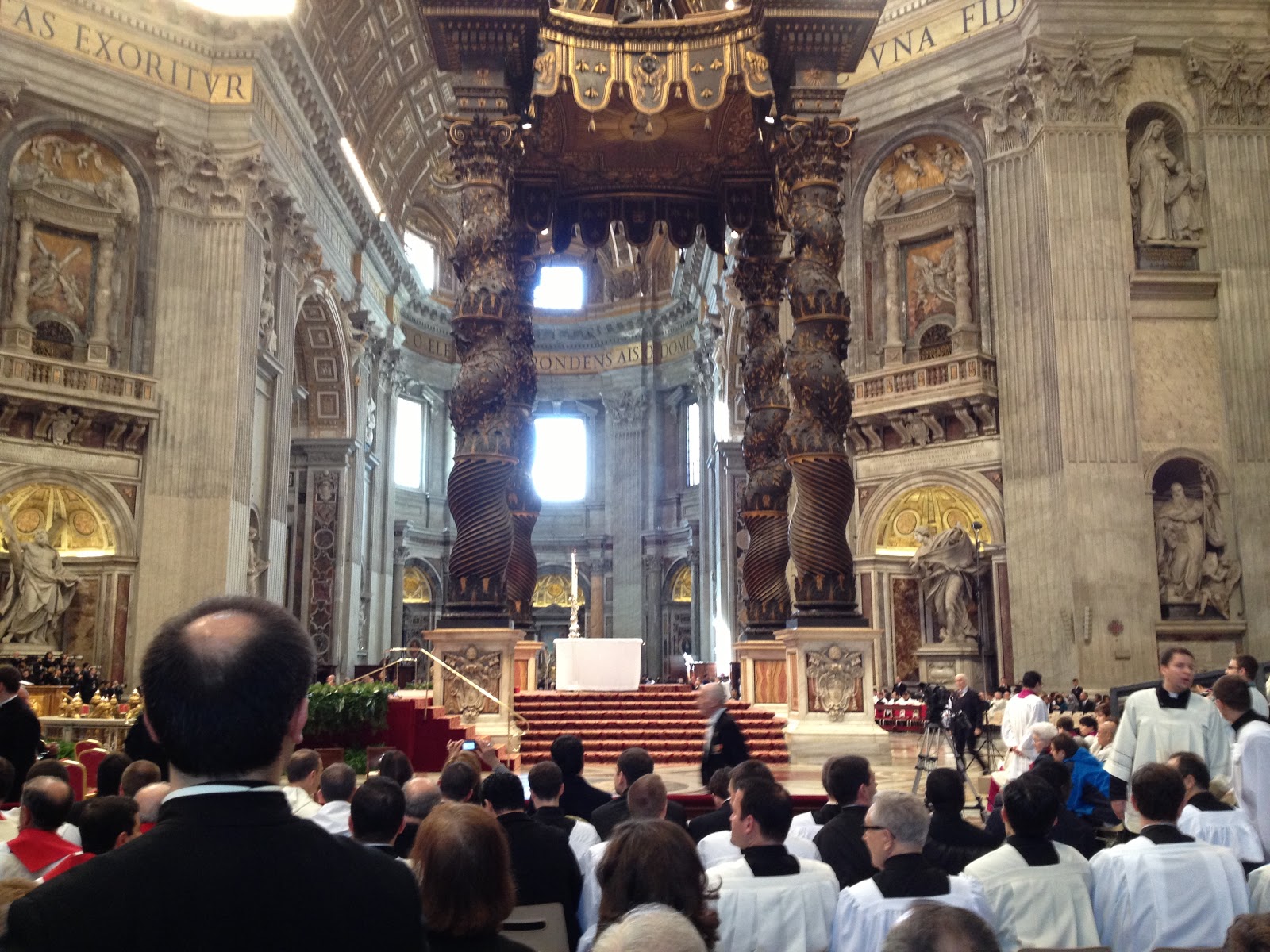
You couldn’t have scripted the three days I spent in Rome for the papal conclave any better than what actually panned out. From beginning to end, the trip had the tone of a pilgrimage and the fingerprints of God’s gracious--and dramatic!--providence all over it. 

Take, for example, some of the not-so-simple details of throwing together a trip to Rome on crazy short notice. Found convenient flights in a few hours. Found a hotel very close to St. Peter’s square. The manager told us we had booked his last room, and he was daily flooded with requests. 

The most dramatic aspect of the experience was the sheer unpredictability of the timing of everything. First, we didn’t know when the conclave was even going to start, and booked our flights based on our best guess. We arrived Sunday night. The opening Mass (Missa Pro Eligendo) was Tuesday morning, and the conclave began just hours later. 

But even more gut-wrenching was the looming uncertainty of when the new Holy Father would be elected. Every single moment of the trip we felt this concern build as a slow burn of anticipation. Granted, if the Pope had been elected after we left Rome--say, Thursday morning or evening, or Friday, or later--it would have been fine. Still a memorable experience, prayerful and all that. 

But when we realized at our very last opportunity for an election that the smoke filling the sky above the Sistine Chapel was in fact white--it first was convincingly black to our eyes--dejection turned into jubilation.  

Wednesday morning I was doing a live interview on Sirius XM radio. Mark Hart, the host and a friend, said at the end of the interview, when he realized how everything (for us, anyway!) came down to the evening ballots, said, “Let me say, brother to brother, that for your sake, I really hope the white smoke comes tonight, so you can experience it all in person.” I told him that’s I’d be okay with whatever God’s will is..but that it seemed strangely unlikely that God would bring me all the way to Rome for a conclave just to have me miss it by a ballot or two, and fly home to watch it on TV in Arizona. Obviously, that wasn’t the plan. 


Now, with tears in my eyes and cranberry juice in hand on flight home, it unmistakably strikes me: as a Catholic who loves the Church, a student of history who loves pivotal moments, a priest who needs the Pope’s guidance and authentic example of priesthood, and as a son who loves his Papa...I’m not sure I could be an ounce happier, this side of eternity.  


___


Wednesday, March 13, 2013

Buzzer beater

I got to St. Peter's square today at 5 pm. It was my last shot at witnessing the election of a Pope, because my flight back to Phoenix is tomorrow morning.

It rained all day. All day. My friends and I wandered all around, chatted with people, and kept staring at the basilica, the tv screens, and other people. Trying to keep dry and warm and upbeat. Black smoke felt...probably.

We waited and prayed and waited some more.

The time for the first ballot of the afternoon came and went. No smoke. No white smoke.

So we waited, and the anticipation grew. Slow burn.


Waiting. Hoping.


Waiting. Waiting.


We prayer vespers. The first night of the conclave the black smoke came out while we prayed the Magnificat.

That didn't work this time.


Then at 7:06 what looked like black smoke appeared, and a spirit of dejection came over us. The crowd sighed, moaned, lamented.


And then someone yelled, "It's white!!!"
And the place went crazy. Elation, joy, bliss. It's winning the super bowl, combined with being a foster child and getting a new Dad. The thought has been crossing my mind..."Would God bring me all the way to Rome for a conclave, just to fly back to AZ and watch it happen on tv?"


 Apparently not!

Rain. Wait. Repeat.

Waiting for the next puff of smoke from the chimney of the Sistine Chapel....

The rain seems undecided here in Rome. I keep going out with an umbrella, and it doesn't rain. And then, like this morning, I went without an umbrella to St. Peter's for a private Mass, and when I exited the basilica later it was pouring.

Here's hoping the cardinals in conclave are proving themselves more decisive than the rain.

I wasn't in Rome during the last conclave, so I don't know what it was like on the ground. But someone who was in Rome then mentioned that the atmosphere was charged with a particular spiritual current. Blessed John Paul II had died, and many of the young pilgrims who flocked to Rome for his funeral were still here for the conclave.

With the quite different circumstances behind the resignation of Pope Benedict XVI, and consequent ambiguous feel of the days between his announcement and the start of the conclave (which was exactly one month, if I'm not mistaken), there is in Rome what I would describe an a kind of uncertainty that borders on uncertainty.

I don't mean that in a necessarily negative way. It may simply be more a reflection of who happens to be in Rome these strange days. Waiting for the first smoke last night, I chatted with various folks in St. Peter's square, asking them where they came from and why they were here.

Some university students told me that they bought tickets to Rome from Cambridge several weeks ago, and it was just chance that they were at the conclave. Other people from the States told me that they planned to come to Rome this week months ago, and it was dumb luck that they were here for the conclave.

So I guess what I'm saying is this:

The vibe is like a World Youth Day...with a few notable differences.

It's cold.

The people who showed up didn't necessarily plan on coming to it.

And no one knows when the Pope is going to arrive.  


Tuesday, March 12, 2013

It's a small world, after all: the pre-conclave Mass

To see St. Peter's Basilica bursting with glorious light, soaring music, and thousands of pilgrims, is a breathtaking phenomenon.


But what really touches me is seeing the approximately 170 Cardinals gathered together and praying the Mass for the election of a Pope.

As they process up to the altar two by two and reverence it with a kiss, I see that they have come from every corner of the world. And here they were, postponing their work back home, to unite together in one spiritual work, the election of a new Roman Pontiff.

Full disclosure: as a Catholic who loves the Church and its history and high theological claims, I can be as lured by the wiles of triumphalism as easily as the next guy. And this moment, with all its glorious beauty and historical weight, could easily have been an occasion for this kind of ecclesial and self back-patting.

In fact, what occurred during the Mass was just the opposite. Moments after moment was marked by a call to tender and heartfelt humility.


One example: the tone (literally and figuratively) of the Mass was set by the opening hymn, Psalm 27, which is essentially a humble and emotional cry to God for help: "Hear the voice of my pleading as I call for help..." The antiphon punctuating the psalm was: "The Lord is the strength of his people, a saving refuge for the one he has anointed. Save your people, Lord, and bless your heritage, and govern them for ever."

These ancient Jewish texts originate from Israel's experience of not only being chosen as God's special inheritance, but also of the way that this "divine election" requires an ongoing process of purification and growth, marked as they were by a history of difficulties, suffering, and, most especially, by God's marvelously faithful interventions.

And now, in this glorious basilica, in 2013, it's clear to me that the claim to be God's chosen people (the "one, holy, catholic, and apostolic church") necessitates a demand to be utterly small, even humiliatingly dependent on God's providence and guidance.

Triumphalism means you hold your present, past, and future into your own capable hands.

But the pre-conclave Mass signaled anything but this kind of self-assurance. It signified something much more beautiful. Human life--perhaps even especially those men called to be Cardinals in the Church--are utterly dependent on the gracious goodness of God for absolutely everything....from life, to faith, to grace for the election of a new Pope.


Monday, March 11, 2013

Whatcha Need on Conclave's Eve

Scouring the streets of Rome the day before a papal conclave is a fascinating experience.

What is really about to unfold in the coming day?

Like so much of what the Catholic Church says, the happenings of a conclave not only borders on, but races straight into, the arms of the humanly impossible: the successor of Peter will be chosen. And he will be chosen in a line of unbroken historical succession, stretching back two millennia. And he will be given the grace to shepherd the universal Church that Jesus Himself founded. 

So today has been, well...strange, trying to take in the feeling, the atmosphere around Rome and the Vatican.

For some tourists who got lucky with scheduling, it's just a spectacle. For flippant and good-humored (but cynical) Roman restauranteurs, it's Rome just being Rome.  For politically and globally (but secular) -minded people, it's the interesting but dumbfounding creaking of a old dusty bureaucratic grandfather clock.   

But for the theologically minded--that is, those who see history as something which God has strangely entered into *(through the very unprecedented events recorded in the documents we call the Old and New Testaments) it is something quite indescribable: the election of the successor of Peter, the Vicar of Christ.

Remember how strange Peter is in the New Testament, especially the Acts of the Apostles. He denies Jesus when it counted most. Then, later on, his shadow heals people when it falls on them. He teaches so powerfully that thousands of people are baptized into the Christian life. He has mystical visions. Apostles like Paul submit their God-given teaching to him for approval. And, as the Gospels hint and history bears out, he humiliatingly sacrifices his life as a witness by a tortuous death, so calmly convinced he was that something worth living--and dying for--had begun in the death and resurrection of Jesus. 

But I guess what hit me today, walking around the almost-too-normal streets of Rome, was how everything Catholics believe about the Papacy as the succession of Peter and Peter's office in the Church (and therefore through normal, "secular" history), is utterly contingent on the active work and guidance of the Holy Spirit. The Spirit that came upon Peter and the other Eleven on that weird morning we call "Pentecost." The Spirit that the 115 men in red will invoke in chant tomorrow morning as they march into another upper room with locked doors. 


....With all this on my mind, I marched up the Gianicolo Hill on the Night Before the Conclave to the North American College (the "NAC"), and offered the Holy Mass at the Pentecost Altar in the crypt chapel. And there I prayed that God would guide the Cardinals (and the whole Church) by means of the absolutely necessary grace of a new Pentecost. Meaning that God would directly guide those entrusted with the universal Church, with Fire that cannot be seen, but whose effects are seen and experienced. 

Meaning that God would give us what we could never give ourselves: a shepherd who will feed His lambs, and tend His sheep, with Divine Life, with Heavenly Fire.  


Manic Monday: Rome 24 hours before a conclave

When the opportunity came up to come to Rome for the conclave, and I prayed that God would direct me to know whether I should do so as a quiet pilgrim in prayer, or share the experience of prayer via Social Media. I sensed that God wanted the latter, so I said, "God, I'm happy to share the experience with anyone you wish."

Since then, in my first 20 hours in Rome, I've bumped into all sorts of interesting media types here to cover the conclave.

For example:

On my flight from London to Rome, the man across the aisle asked me if I was going to the conclave. I said yes, and we had a lovely chat the rest of the flight. Turns out, the gentleman is Sean Klein, the Bureaux Editor for the BCC, for the entire continent of Europe. He is here with a huge gaggle of reporters from the BCC to cover the conclave. We chatted about journalism, languages, paparazzi, and how faith factors into the professional life of a journalist in Europe these days.


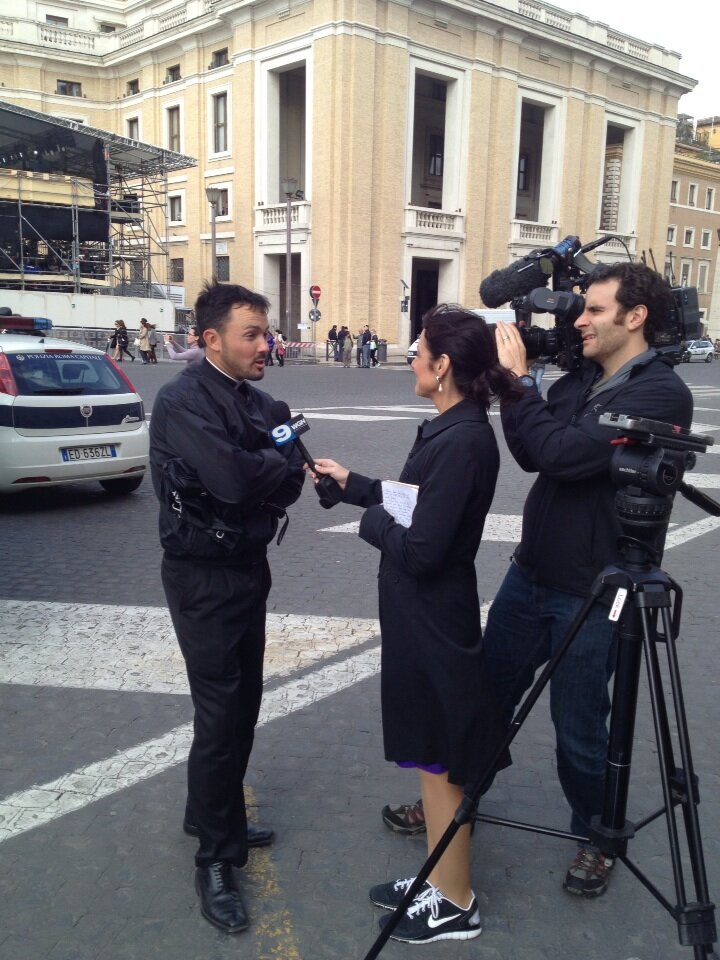
At the east edge of the St. Peter's square a host of journalists are gathered. I bumped into the team from WGN in Chicago and chatted with them about why I am in Rome and what the conclave means to me as a priest and a Catholic. They were particularly interested in the fact that I studied in Chicago at Mundelein Seminary for 5 years. Watch WGN tonight and see if my mug gets on there. On the WGN website they said they spoke with a seminarian from Chicago...um, hey WGN, I hope you didn't mean me. I'm neither. Check out my beard, you know? I'm old!


Later in the day, strolling by the well-known Via Borgo Pio just north of the Vatican, I bumped into Fr. Jonathan Morris from Sirius XM. He has been doing wonderful short interviews with Cardinal Dolan from the North American College.

There is a calm anticipation all around Rome, perhaps it would seem like a normal March day, except for details here and there...The windows of the Apostolic Palace shuttered. Pictures of Pope Benedict XVI Emeritus on the back of buses, with the word "Grazie!", "Thank you!" above it. Press boxes going up in random places. And my favorite...I was sitting outside at lunch enjoying great, simple Roman pizza with seminarians and priests and other friends, when we saw a cardinal quietly duck into the front door of the little church just behind us.

Apparently he has something on his heart to bring to prayer.

Saturday, March 9, 2013

GOING TO THE CONCLAVE!

I'M GOING TO THE CONCLAVE!!!!!!!!

Now, slightly calmer...

I'll be in Rome starting the Sunday before the conclave. I'll be there as a pilgrim and a priest. And I'm looking forward to sharing the experience with everyone who is interested in my experience there. I plan on being all around the goings-on around the Vatican. I predict the unpredictable!

I'll posting here on this blog a few times a day. I'll be tweeting from @Fr_JMuir and also on my Facebook page, for FrJohn Muir. Feel free to follow along, comment, and above all, to pray with me!

Friday, March 8, 2013

priesthood and a dead end

As we get ready for the election of a new Pope, let's refresh our memories about how central to Jesus and the Church--and indeed, the Papacy--is the notion of priesthood.  And if I'm not mistaken, this is first time in a video Fr Barron has ever said the words, "I'm the emperor of China."

Don't we sometimes find ourselves--perhaps unconsciously--making similar assumptions as Garry Wills? When in fact the New Testament present Jesus--Fr Barron is saying--as restoring and transforming the notion of priesthood in his person and work.

Monday, October 15, 2012

Year of Faith...it's on, and here's why


Happy new year...the new “Year of Faith.”
What's the Year of Faith about? What's it for? 

Both the Holy Father and Bishop Olmsted have said that the year is really two-fold: first, the rediscovery and recommitment of our faith on a deeply personal level; and second, to dedicate ourselves to renewed efforts to proclaim, teach, and, when necessary, to defend our faith in Christ.

Our central conviction as Catholic Christians is that God has come to us in His Son Jesus Christ, and invited us into an unimaginable friendship that will never end.  Faith, then, is the door to this friendship. Our Catholic faith is the fullest expression of this friendship with God up and down the centuries. The Church doesn't just have a mission; the Church is a mission. 

I couldn't think of a more exciting time to be Catholic than right now, to take up the challenge of renewing our faith and our commitment to proclaim it in re-energized ways.

To best understand the context of the year of faith, we have to see it in light of the Second Vatican Council. 

Fifty years ago the Second Vatican Council had its opening session in October of 1962. What was the situation at the time? Europe, and actually much of the developed world, lay exhausted and scorched by two World Wars of unprecedented destruction and cost. Two bombs added to the uncertainty of the future, one literal and one figurative: the atomic bomb and the pill. The first unleashing technology's power over the future of human life, and the second harnessing technology's power of the origin's of human life. Our beginning and our end seemed to be in our own trembling hands. A time of terrible threat and exhilarating promise. 

And God sent us Pope John XXIII, good and jovial and rotund Pope John, who with sense of humor and humility galvanized the Church with a new sense of hope. He signaled that the Church was abandoning her defensive crouch behind her walls, and throwing open the windows, so that the world might see in and the Church might see out. The Church, he knew, possesses the Good News of Jesus Christ, the "Light to the Nations," Lumen Gentium, and it was time for that Light to Shine forth in a new brilliance.

How did the windows of the Church end up closed?

Let me take you back about four hundred years, to the origins of what we call modernity, a whole philosophical movement whose central concern is the subject, or the interiority of the individual. The self. 

You know of the great founding fathers of modernity from your philosophy classes: from Rene Descartes' wrecking ball of radical doubt, finding solid ground only in the thinking and doubting self "I think therefore I am,"...to Martin Luther's obsessive search for certainty over his own personal salvation in which he wielded his wrecking ball against anything exterior to the interior act of faith...to Immanuel Kant's conviction that the human person cannot be used as a means to something else, but must be treated as an end in him or herself...

This was all new, this turn to the subject, to the interior life of the individual, to personal human dignity. And obviously, there is much to say for this, the modern notion of human rights, just to mention one positive. 

But an obsession with the scientific method as the privileged way to knowledge, coupled with radical skepticism about the past--and a prejudice against anything exterior to the subject--led to a fundamental equating of the old with the bad, and the new with good. This attitude found expression in the last years of the 1700's, in the so-called Enlightenment.

In 1789, this movement showed its dark underbelly, its bloody teeth. The French Revolution in particular--a vicious reaction against the past and its accoutrements--led to priests, nuns, bishops, normal Catholics, too, being imprisoned, tortured, executed. This experience penetrated the heart and memory of the Church with a deep wound. And, consequently, a defensive posture resulted. 

Through the 1800's this defensive posture endured, expressed clearly in any number of official Church condemnations against the heresies of modernity. The first Vatican Council, in 1870 began to provide a response beyond this evangelically weak defensiveness, but was cut short due to war, and so the Church's response remained in suspense. 

But by the middle of the 20th century, with the Church holed up behind her walls, dust settling on the incalculable physical destruction of war, we modern people found ourselves wandering through bombed out cities, literally and figuratively picking up the smashed fragments of meaning and purpose. In the 20th century, many voices provided clues to the search for purpose and meaning (e.g., Karl Marx: the material of production and economics; Sigmund Freud, the latent forces of sexual desires; Jean Paul Sartre, freedom from nature in favor of radical autonomy; Friedrich Nietzsche, the will to power.) 

We couldn’t quite put Humpty Dumpty back together again...in a way that the modern culture found convincing. None of these competing voices could provide the personal and cultural resurrection for which modernity was searching.  

So, prompted by Pope John XIII, the Church came to grips with this: in her defensive crouch, her voice was not being heard. Modernity--despite its conviction to the contrary--had never really heard the Gospel. 

Like the rich young man in the gospels, the modern world had never really heard the voice of Jesus Christ saying, "If you want eternal life....sell what you have, give to the poor, and follow me!" Like the young man, fascinated only with his own devices, the modern world couldn't see past its own interior powers to the Other, to God, to Christ; it had not yet learned to be fascinated with following the call of crucified Love. 

So it dawned on Pope John XXIII: the modern world hadn't really rejected the gospel. It hadn't heard the gospel, the good news, at all. And the Second Vatican Council proposed to renew the faith of those who had met Jesus Christ, and then unleash them like a living fire into the world. This wasn't a Council to condemn heresies; it was a Council to captivate "modern" hearts and turn them loose ablaze with divine Love. 

Bishop Olmsted said at the opening Vespers for the Year of Faith that every Council in history is usually followed by 50 years of craziness and confusion, and then, often, great things happen. He said, "We're right on schedule." But the success of the Council is no guarantee. Some Councils that wanted great reforms fizzled out. In 1517 the V Lateran Council proposed great reforms. Catholics shrugged their shoulders and the response was underwhelming. Four years later the Protestant reformation erupted. 

Some Councils succeed. Perhaps most of the (there have been 21) were great successes, like the Council of Trent, for example, in 1570--exploding into wildly fresh displays of faith in art, music, teaching, preaching, missionary life, ethical reforms, etc.  

What about the Second Vatican Council, whose texts are our marching orders? Will it fizzle, or will it change the course of history? It's for us to decide, you and I. This is our time to live, to decide, to act. 

The Council's success will depend on our faithfulness to Christ. On our holiness; on our distinctive happiness of life. Will we--we modern people, so in tune with the unique desires of the subject, the self, the person--will we receive and share the Light to the Nations in the way radical way the Council invites us to? 

Even though our generation hangs in the balance, as does every generation, finally we know the victory is Christ's. This is our faith. In him, our victory is assured--for if God is for us, who can be against us?

Monday, February 6, 2012

Jesus and the Rise of a new Fatherhood

It's rarely spoken about, but one of the undercurrents in the Gospels is the way that Jesus heals broken fatherhood. He heals all creation, but in a particular way, he comes to heal our image of fathers and fatherhood. "When you see me, you see the Father," he says in the gospel of John.

But look how clearly and strikingly the readings from Mass a few days back make this point: Mark 5:21-43, and 2 Sam 18.

Jairus, the synagogue official, implores Jesus to heal his daughter who is on the point of death. There is no indication that Jairus is a bad father at all; in fact he seems to be doing all he can to help her. But that's just the point: earthly fathers alone cannot provide what human beings really need, no matter how good they are. Jairus cannot save his daughter from death, even a young death. Jesus responds by going off with him to help her, to provide what this good-willed father cannot provide on his own: life.

On the way, Jesus meets another hidden crisis of fatherhood. A woman who had a hemorrhage meets him. Mark tells us she had suffered greatly at the hand of many doctors and had spent all she had. But she only got worse. Though the text doesn't tell us explicitly, there is an implicit judgment we might draw: where was her father? Why was she pouring her resources and not him? She is apparently alone and growing destitute and hopeless on her own. Her father could not protect her from illness and social stigma and poverty. Maybe he tried his best, maybe not; but he is not there. He's gone. She's alone. If this theme of fatherhood seems a stretch, simply hear what Jesus calls her when he finally lays eyes on her: "Daughter." In touching his cloak, she touches the power and love of a Father who loves her. And she is healed.

But during this delay along the way, it seems that Jesus has failed as a substitute father to Jairus' daughter. The report comes that she had died. It seems as though Jesus claim to simply heal the girl and restore her to her father is ridiculous. The crowd laughs at him and mocks him. After all, too much damage is done, too much water under the bridge. He ignores the nay-sayers and proclaims, "The child is not dead but asleep." Even physical death does not put the girl outside of his fatherly care, though she is out of the reach of Jairus.

Jesus remarkably takes on the role of the father of the house: he tells certain people to leave the house, guides the parents (it is their house!) through the house to the girl's room, and takes the child by the hand. She arose immediately. His fatherly providence continues, telling them to give her something to eat. While he restores the parents to their role in the girls life, it is clear that Jesus brings a fatherly identity and power with greater authority than that of natural parents and even the forces of nature.


How often do we think of Jesus as a father? Recall that he is called the "son of David" on several occasions. David himself was a father whose love for his son was stronger than even the most heinous betrayals. When his rebellious and treasonous son Absolom is finally killed, David cries out, "My son, Absalom! My son, my son Absalom! If only I had died instead of you, Absalom, my son, my son!" If this is true of David, how much more true is it of Christ, who consummates the desire we see in David's heart, to die for his beloved child on the Cross?

Especially for us men--whether fathers physically or spiritually, directly or indirectly--we can find great strength knowing that Jesus opens up for us a great hope: he is fatherhood healed of all brokenness, neglect, and selfishness. We men are hard-wired to give and protect life, but this can seem to daunting to commit to for a lifetime, or, given our own weaknesses even for a week, sometimes. But Jesus comes to undo the fall, and this includes the fall of the first father. He gives life and protects us in His Church. He can teach us how, too.

Tuesday, January 10, 2012

Treasure under the house: the intellectual riches of Christology

If you asked me what my favorite class was, in all those great years during my formal studies for the priesthood...I'd say probably Christology. The study of Christ. Sounds funny, but until I arrived at the hallowed halls of my two seminaries (in Denver and Chicago, respectively), I honestly had no idea such a thing even existed.

At first hearing, I thought "Christology" was a joke. Literally. Or, at best, I thought maybe it was a topic some professor had made up on a whim, with tongue slightly in cheek. The study of Christ? Who ever heard of such a thing? The "logy" of bio-logy...socio-logy...anthropo-logy...that seemed to make sense given the relative pin-downability of those areas of study (life, peoples, man, etc.). But taking class on the Lord Jesus? What do we think he is, a dead butterfly? It was like taking a class on my Mom, or my Dad. How would you possibly catch and study someone so mysterious and, well, huge? I assumed: "I know Jesus... I don't need a class on him."

Turns out, Christology was, and is, pretty darn real. In fact, I discovered that the first six or seven centuries of Church history resembled a long intellectual wrestling match of the greatest human minds with answering this basic question: Who the heck is Jesus Christ? How can we possibly make sense out of Him?

I realized that, despite my Catholic upbringing (no, I didn't go to Catholic schools growing up.)  how little intellectual content I possessed regarding some somewhat simple questions: How was Jesus God and man? Did he have a soul? Did he know everything? How did he pray? Did he fear death? Did Jesus know he was God? Did he have two minds? Did he know he would rise from the dead? Was Jesus Jewish or Catholic or both or neither? Did Jesus think about me while he was on the cross?

I took the class--it was January, 2004--and my Christology class blew me away--not because it was the best-taught class necessarily, or because class interaction was the best, but because the intellectual content which provided logically coherent and rich answers to these questions was like discovering a massive cave of treasure under my house. I had no idea, but it was there all along, and my mind started coming alive as a Catholic in a new way.

The treasure I discovered was made up of intellectual heroes, giants, speaking to me from across the centuries: Sts. Paul, Iranaeus, Athanasius, Cyril of Alexandria, Gregory of Nazianzen, Basil and Leo the Great, Augustine, Ambrose, and a host of others, unfolding the Mystery of Christ in ways I intellectually thirsted for, thought I hardly dared to ask the questions.  I had never experienced my heart and my mind being so united and exhilarated by anything quite like that ever before. These men helped to transfer me, whole and entire, from adolescence to adulthood in terms of my Catholicism; they certainly also helped me entertain the feasibility spending all my twenties studying Christ full-time, which I ended up doing.

Now, as a priest at the largest university in the United States of America, I'll be sharing some of these riches in a weekly Christology course for any interested students. It'll be my first crack at teaching a university level course on campus--thought not-for-credit--but I'm very interested to see what kind of discussion and interest it generates. In an environment that often scoffs at the intellectual rigor of Christianity, I hope it will be helpful. If the material has half the effect on others that it had on me in my twenties, it'll be well worth the effort.

See www.asucatholic.org for details on the free class.